
Precision Metal Processing Guide 2026 | HUAZHI Mold
What is Precision Metal Processing? A Complete Guide to 2026
In the rapidly evolving landscape of modern manufacturing, the demand for components that fit together with microscopic accuracy has never been higher. As we look towards 2026, the ability to produce parts with tight tolerances is no longer a luxury—it is a necessity. This comprehensive guide dives deep into the world of Precision Metal Processing, exploring its methodologies, applications, and why it is the backbone of high-tech industries ranging from automotive to medical devices.
Whether you are an engineer sourcing components or a business owner looking to upgrade your production capabilities, understanding Precision Metal Processing is key to staying competitive. Let’s explore how this technology is shaping the future of manufacturing.
Understanding Precision Metal Processing
At its core, Precision Metal Processing refers to the specialized techniques used to shape, cut, and form metal components to exact specifications. Unlike traditional machining, which often allows for wider tolerances, precision processing demands accuracy measured in microns (µm).
This process involves the removal of material from a workpiece using computer-controlled tools. The goal is to achieve a level of consistency and accuracy that is virtually impossible to replicate by hand. In 2026, this technology has evolved to handle complex geometries and exotic materials with ease, making it indispensable for industries where failure is not an option.
For a deeper historical context on how these numerical control systems revolutionized the industry, you can review the history of numerical control.
The Core Technologies Behind the Process
Modern Precision Metal Processing relies on a suite of advanced technologies, primarily centered around Computer Numerical Control (CNC) machining. These systems interpret digital 3D models and translate them into physical parts with remarkable speed and accuracy.
Key technologies include:
- CNC Milling and Turning: The workhorses of the industry, capable of creating complex shapes from solid blocks of metal.
- Wire EDM (Electrical Discharge Machining): Used for cutting intricate contours and sharp internal corners that traditional tools cannot reach.
- Grinding: Essential for achieving ultra-fine surface finishes and tight dimensional tolerances.
The integration of Artificial Intelligence (AI) in 2026 has further enhanced these capabilities, allowing machines to self-optimize for better efficiency and reduced waste.
Why Tolerances Matter in 2026
In the context of Precision Metal Processing, tolerance refers to the permissible limit of variation in a physical dimension. In 2026, standard industrial tolerances have tightened significantly.
For example, in the aerospace industry, a variation of even 0.01mm can lead to catastrophic failures. Similarly, in the medical field, implants must fit the human body perfectly to ensure patient safety. Precision Metal Processing ensures that every single part produced matches the blueprint exactly, batch after batch. This consistency is what allows complex machinery—like the engines in your car or the scanners in a hospital—to function reliably.
Applications Across Key Industries
The versatility of Precision Metal Processing makes it a critical component in various high-stakes sectors. Let’s examine how different industries utilize this technology.
Automotive and Transportation
The automotive industry is one of the largest consumers of precision metal parts. From intricate fuel injection systems to transmission components, Precision Metal Processing ensures that vehicles are not only powerful but also fuel-efficient and safe.
As the industry shifts towards electric vehicles (EVs), the demand for precision gears and motor components has skyrocketed. These parts require flawless execution to maximize the performance of electric drivetrains.
Medical Devices and Healthcare
In the medical field, precision is synonymous with life. Precision Metal Processing is used to manufacture surgical instruments, orthopedic implants, and diagnostic equipment.
Materials like Titanium and Stainless Steel are processed to create implants that must integrate seamlessly with the human body. The biocompatibility and accuracy achieved through this process are vital for successful medical outcomes.
Consumer Electronics
Every smartphone, laptop, and wearable device contains dozens of tiny metal components. The frames, connectors, and shielding within these devices are all products of Precision Metal Processing. As electronics continue to shrink in size while increasing in power, the demand for micro-precision machining grows exponentially.
The Future of Precision Metal Processing in 2026
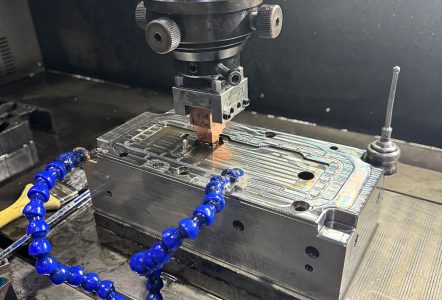
As we move further into the decade, the future of Precision Metal Processing is being shaped by sustainability and digitalization.
Key trends to watch:
- Green Manufacturing: There is a significant push towards reducing coolant usage and recycling metal chips. Advanced dry machining techniques are becoming the norm.
- Additive and Subtractive Hybridization: While traditional processing is subtractive (removing material), the future lies in combining it with additive manufacturing (3D printing) to create near-net-shape parts that require minimal finishing.
- Hyper-Automation: Lights-out manufacturing, where factories operate autonomously overnight, is becoming more prevalent, driven by the need for 24/7 production cycles.
Why Choose HUAZHI Mold for Your Needs?
While HUAZHI Mold is renowned for its expertise in injection molding and custom mold design, our capabilities extend into the realm of high-precision support. We understand that complex plastic parts often require equally complex metal fixtures and molds.
Our commitment to utilizing the latest technology ensures that whether you need a custom mold or a precision metal component, you receive a product that meets the strictest standards. We serve a wide range of industries, including automotive, home appliances, and medical devices, ensuring that your project is in expert hands.
If you are looking for a partner who understands the intersection of plastic and metal manufacturing, contact us today to discuss your project.
Frequently Asked Questions (FAQ)
What is the difference between standard machining and Precision Metal Processing?
Standard machining typically deals with looser tolerances and is often used for roughing out shapes or non-critical parts. Precision Metal Processing, on the other hand, focuses on achieving tolerances within microns. It utilizes higher-grade machines, specialized tooling, and often stricter environmental controls to ensure that every dimension is perfect.
What materials can be used in Precision Metal Processing?
Almost any metal can be processed with precision. Common materials include Aluminum, Stainless Steel, Titanium, Brass, and Copper. In 2026, there is also a growing trend in processing exotic superalloys like Inconel, which are used in extreme environments such as jet engines and chemical processing plants.
How do I know if my project requires Precision Metal Processing?
If your project involves moving parts that must fit together without excess play, or if it is used in a safety-critical application (like medical or aerospace), you likely need Precision Metal Processing. If standard hardware store parts don’t fit your specifications, it’s time to look for a precision manufacturer.
In conclusion, Precision Metal Processing is not just a manufacturing method; it is the foundation of modern engineering excellence. As we navigate the technological advancements of 2026, the ability to create components with microscopic accuracy will continue to drive innovation across all industries.
Whether you are designing the next generation of medical devices or upgrading your automotive components, partnering with a manufacturer that understands the nuances of tight tolerances is crucial. Don’t let subpar components hold your project back.
Contact HUAZHI Mold today to discuss how our expertise in high-precision solutions can bring your vision to life.